Har HaZeitim (Mount of Olives) — The World’s Holiest Jewish Cemetery
Har HaZeitim — the Mount of Olives — is the oldest continuously used Jewish cemetery in the world, and the most sought-after burial and pilgrimage site in Jewish tradition. Rising on the ridge east of Jerusalem’s Old City, directly facing the Temple Mount, it has held Jewish burials for roughly 3,000 years.
A Cemetery Older Than History
Burials on Har HaZeitim date back to First Temple times, making it one of the few places on earth with an unbroken Jewish burial tradition spanning three millennia. Today the mountain holds an estimated 150,000 graves, layered across its slopes in a view that has become one of the most recognizable images of Jerusalem.
Why It Is Considered the Holiest Jewish Cemetery
According to Jewish tradition, when the resurrection of the dead (Techiyat HaMeitim) begins, it will start on the Mount of Olives, since it faces the site of the Holy Temple. This belief has drawn Jews from around the world to seek burial there for centuries. The prophet Zechariah’s own prophecy about the Mount of Olives (Zechariah 14:4) is closely tied to this tradition. Among the many buried on the mountain are renowned rabbis, sages, and public figures — including Israel’s sixth Prime Minister, Menachem Begin, who chose to be buried on Har HaZeitim rather than among his fellow leaders.
- Location: East of Jerusalem’s Old City, facing the Temple Mount
- Age: Jewish burials for roughly 3,000 years
- Size: An estimated 150,000 graves
- Significance: Traditionally considered the starting point of the resurrection of the dead
Visiting Har HaZeitim From Abroad
For families living outside Israel, visiting a parent’s or relative’s grave on Har HaZeitim for the Yahrzeit is often simply not possible. Flights, timing, and travel logistics stand in the way of a mitzvah that Jewish law and custom treat as deeply significant. Halacha requires a Minyan of ten men for Kaddish to be recited, and tradition calls for Tehillim, El Maleh Rachamim, and a candle lit at the grave — none of which a family member abroad can arrange alone from a distance.
How We Can Help at Har HaZeitim
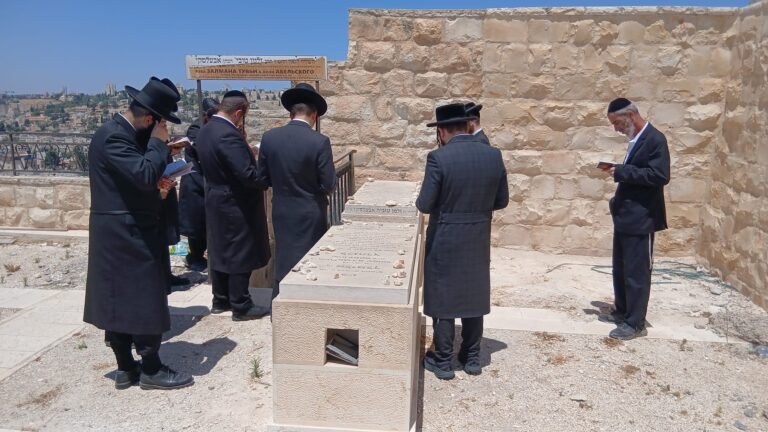
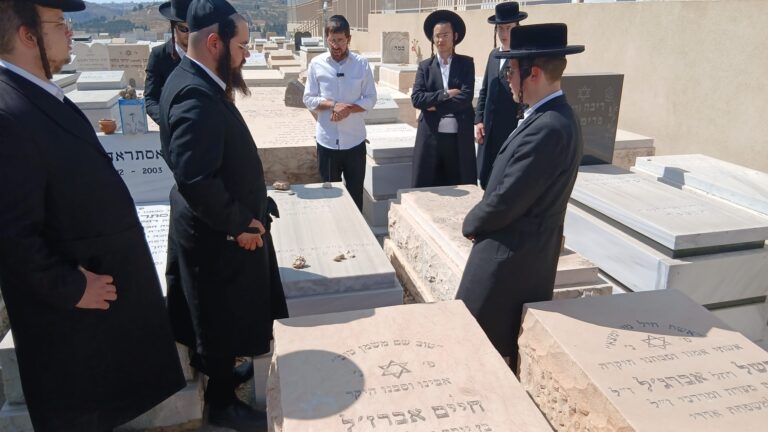
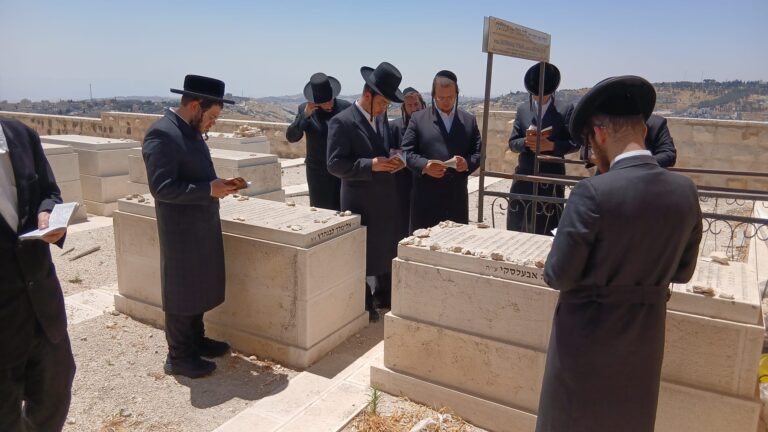
Yahrzeit Minyan Jerusalem arranges a full graveside Minyan of G-d-fearing yeshiva students at Har HaZeitim, along with Har HaMenuchot and Sanhedria Cemetery. We locate the grave, bring ten men for Kaddish, recite Tehillim by the letters of your loved one’s Hebrew name, say El Maleh Rachamim, and light a memorial candle — then send you real-time photos over WhatsApp so you can feel present, even from thousands of miles away. See our full Kaddish and Minyan services, or read our guide on how to arrange Kaddish at a grave in Jerusalem when you live abroad. You can also generate a personalized Tehillim reading free, based on the letters of your loved one’s name.
Can anyone be buried on Har HaZeitim today?
Burial plots on Har HaZeitim are limited and typically arranged well in advance through Jerusalem burial societies (Chevra Kadisha). Our service focuses on visiting and honoring graves that already exist there — not new burial arrangements.
Do I need to be in Jerusalem to arrange a Minyan at Har HaZeitim?
No. Families anywhere in the world can contact us by phone or WhatsApp, and we arrange the entire visit — transport, the Minyan, Tehillim, Kaddish, and photo documentation — on your behalf.
How steep or accessible is the cemetery?
Har HaZeitim is built on a steep hillside with many stepped paths. Our teams are experienced in locating graves across the mountain and arranging private transport as close as possible to each site.
Honor a Loved One at Har HaZeitim
Let us arrange a full graveside Minyan, Kaddish, and Tehillim — with real-time photos sent directly to you.
Message on WhatsApp View Our ServicesMore Jerusalem cemetery guides: Har HaMenuchot · Sanhedria Cemetery · Har HaZeitim
Related guides: Tehillim at the grave · What happens when we visit a grave for you · How to find the yahrzeit date
Finding a Grave on Har HaZeitim
The cemetery covers the western and southern slopes of the Mount of Olives and holds a vast number of graves, some from the First Temple period and many from the last few centuries. Sections are arranged by the communities and burial societies that used them — Ashkenazi, Sephardi, Chassidic and others — and many older stones are worn or were damaged in the years before 1967. Knowing the section and the name on the stone makes a visit far easier. An information center near the cemetery helps visitors locate specific graves by name.
Practical Tips for a Visit
- Visit with others, or with organized transport, rather than walking up alone
- Bring the full Hebrew name, the father’s name and, if you have it, the section and plot details (see finding the Hebrew name)
- Wear comfortable shoes: the paths are steep and uneven
- Follow the customs of visiting a Jewish grave and wash your hands when leaving
Frequently Asked Questions
Can you hold a minyan at a grave on Har HaZeitim?
Yes. Our minyan of yeshiva students travels to the grave by private transport, says Tehillim by the letters of the name, Kaddish and El Malei Rachamim, and sends you photos and video on WhatsApp.
What if I do not know where the grave is?
Send us the name, the father’s name and the date of passing. We will work to locate the grave before the visit.
Is it possible to visit on the yahrzeit itself?
Yes — we schedule the visit for the Hebrew date you give us. If you are unsure of the date, see how to find the yahrzeit date.
More guides: Customs when visiting a Jewish grave · Visiting graves in Elul · The first yahrzeit